By late September, school is in full swing. Coughs, sniffles, and runny noses are making their way through classrooms, but knowing the difference between a cold, flu vs. allergies can help you decide when your child should stay home and what to do next.
Many childhood illnesses share symptoms, and sometimes testing or an exam is necessary to know exactly what is going on. However, there are some helpful clues you can look for.
In this guide, I’ll walk you through how the cold, flu, vs. allergies in kids commonly present, when your child should stay home from school, what you can do to support them at home, and, most importantly, the signs that tell you it is time to call your pediatrician or seek medical care.
This information is intended for general education and does not replace individualized medical care. If you are concerned about your child, contact your pediatrician.
Cold, Flu vs. Allergies in Kids
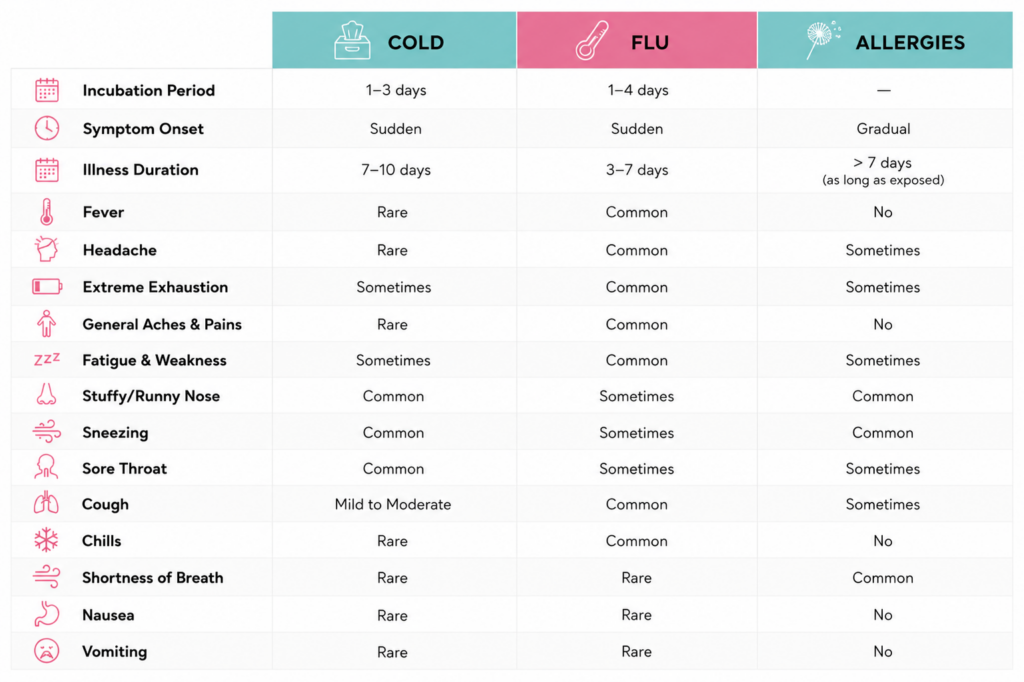
Runny noses, congestion, coughs, and fatigue can occur with more than one condition, so rather than focusing on a single symptom, pay attention to the overall pattern.
Common Cold
Colds are caused by viruses and commonly include:
- Runny or stuffy nose
- Cough
- Sore throat
- Sneezing
- Lower energy
- Sometimes fever or mild body aches
Cold symptoms are typically milder than flu symptoms. Children often begin feeling better within several days, although some symptoms can take up to two weeks to completely resolve.
Influenza (Flu)
Flu tends to hit harder and more suddenly.
Common symptoms include:
- Fever or chills
- Cough
- Sore throat
- Runny or stuffy nose
- Headache
- Muscle and body aches
- Significant fatigue
Children may also experience vomiting or diarrhea with influenza. Not every child with the flu will have a fever.
If your child suddenly goes from feeling fine to wanting to lie on the couch with body aches, fatigue, headache, and fever, it may be the flu.
Flu vaccination is also an important part of the conversation around influenza prevention. Talk with your child’s pediatrician or healthcare provider about the flu vaccine and what is appropriate for your child based on their age, health history, and individual needs.
Seasonal Allergies
Seasonal allergies tend to look a little different because your child is reacting to an environmental trigger rather than fighting an infection.
Look for:
- Frequent sneezing
- Clear, watery runny nose
- Stuffy nose
- Itchy nose
- Itchy, red, or watery eyes
- Symptoms that persist or repeatedly return with allergen exposure
Fever and body aches are not typical of seasonal allergies. Itching, especially itchy eyes and an itchy nose, is also much more characteristic of allergies than a cold.
For children who need additional fall allergy support, I often use HKHM Hist-Assist (capsules) or HKHM Hist-Assist Jr. (chewables). These formulas are designed to support healthy histamine balance and comfortable nasal and sinus passages during seasonal and environmental challenges.
Remember that these are general patterns, not diagnostic rules. Other respiratory infections can cause overlapping symptoms, and your pediatrician can help determine whether your child needs an exam or testing.
Cold, Flu vs. Allergies: Should My Child Stay Home From School?
Not every runny nose automatically means your child needs to stay home from school. A better question is:
How is your child actually feeling and functioning?
According to current CDC guidance, children should generally stay home if they:
- Have a fever.
- Have vomited more than twice in the previous 24 hours.
- Have significant diarrhea.
- Have respiratory symptoms that are worsening or not improving and are not better explained by something like seasonal allergies.
- Are too tired or uncomfortable to participate normally in the school day.
- Need a level of care that school staff cannot reasonably provide.
For a respiratory illness, a child can generally return to school once symptoms have been improving overall for at least 24 hours and they have been fever-free for at least 24 hours without fever-reducing medication. They should also feel well enough to participate in a normal school day.
Seasonal allergies are different because they are not contagious. If your child is otherwise feeling well and able to participate at school, allergy symptoms alone do not necessarily require a sick day.
Always check your child’s individual school or district illness policy, since local requirements may vary.
Viral vs. Bacterial Infections: Why the Difference Matters
Most routine childhood colds and cases of influenza are caused by viruses.
Antibiotics do not treat viral infections. They are used for certain bacterial infections and will not make a cold or the flu go away faster.
Many viral illnesses simply need time and supportive care. The acute care guidance we use with families emphasizes that viral illnesses can involve cough, congestion, runny nose, fever, vomiting, diarrhea, or even a temporary rash.
One thing I pay close attention to is the direction the illness is going.
If your child was improving and then suddenly gets worse again, or a fever or cough improves and then returns, contact your pediatrician. That change in pattern deserves another look.
What You Can Do at Home When Your Child Is Sick
For an uncomplicated viral illness, much of acute care is about keeping your child comfortable, hydrated, and rested while their body recovers.
You also do not need to introduce ten new supplements the minute your child gets sick.
Regardless if you are trying to keep your child healthy from the cold, flu vs. allergies, I prefer to build the foundation consistently. HKHM Vitamin D3 + K2, HKHM Advanced Vitamin C, and HKHM Plantadophilus are examples of supplements we use as part of an ongoing routine to support normal immune function, antioxidant status, and a balanced gut microbiome.
If these are already part of your child’s individualized plan, consistency is generally more useful than trying to completely overhaul their routine when illness hits.
Prioritize Fluids
When kids are sick, I worry much less about whether they are eating a full meal and much more about whether they are drinking and urinating normally.
Offer fluids frequently throughout the day.
If your child is vomiting or has diarrhea, small, frequent amounts may be easier to tolerate than trying to drink a large amount at once.
Watch for signs of dehydration, including significantly decreased urination, a dry mouth, lack of tears when crying, unusual sleepiness, or difficulty keeping fluids down.
Help Clear Congestion
For a stuffy or runny nose, simple strategies can make a big difference:
- Use saline nasal spray or drops.
- For babies and younger children, use saline followed by gentle suction to help clear mucus.
- Run a clean cool-mist humidifier.
- Try a warm, steamy shower or spend a few minutes in a steamy bathroom.
- Encourage plenty of fluids and rest.
For older children who use a neti pot or other nasal irrigation device, water safety is extremely important. Use only distilled, sterile, or previously boiled and cooled water and follow the manufacturer’s instructions for cleaning the device.
Support a Healthy Inflammatory Response
I also think about supporting the body’s normal inflammatory and recovery processes when kids are sick.
HKHM PureZyme and HKHM ProZyme are systemic enzyme formulas we use as supportive care to help maintain a healthy inflammatory balance and comfortable mucus consistency during illness or congestion.
Unlike digestive enzymes, systemic enzymes are typically taken away from meals so they can be used for whole-body support rather than food digestion.
Try Honey for a Cough
For children over 1 year old, honey is one of my favorite simple tools for soothing a cough.
You can give it by itself or add it to warm water with a little lemon.
Never give honey to a baby under 1 year old because of the risk of infant botulism. Current pediatric guidance also advises against over-the-counter cough and cold medicines for young children.
Cold, Flu vs. Allergies: What About a Fever?
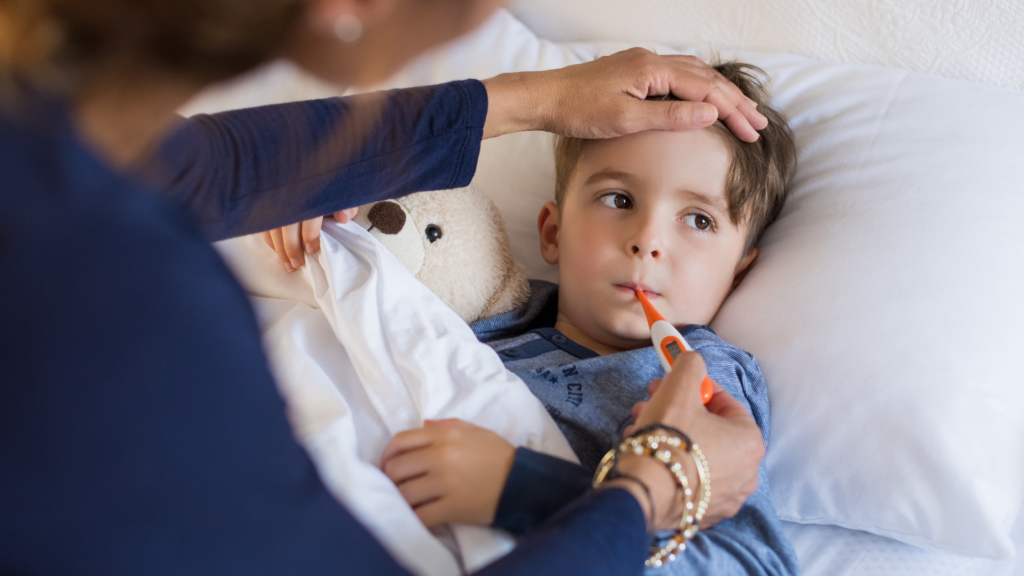
A fever is one of the body’s natural responses to infection, and the number on the thermometer is only one part of the picture. It’s also important to consider:
What does your child look like and how are they acting?
Are they drinking? Urinating? Talking to you? Smiling or playing when their temperature comes down?
Or are they unusually sleepy, difficult to engage, refusing fluids, or still looking very sick even after the fever decreases?
That overall behavior matters. Call your pediatrician about a fever when:
- A baby younger than 3 months has a temperature of 100.4°F (38°C) or higher.
- Fever lasts more than 24 hours in a child younger than 2.
- Fever lasts more than 3 days in a child age 2 or older.
- Your child continues to act sick after the fever comes down.
- Your child seems to be getting worse rather than better.
You should also contact your pediatrician as soon as possible whenever your child’s symptoms or behavior concern you.
If You Think Your Child Has the Flu, Call Early
If your child’s symptoms strongly suggest influenza, particularly if they came on suddenly, it can be worth calling your pediatrician sooner rather than later.
Prescription antiviral medications are available for influenza and work best when started within one to two days after symptoms begin. Starting later can still be beneficial for some children, particularly those who are very sick or at higher risk of flu complications.
Your pediatrician can help determine whether testing or antiviral treatment makes sense for your child.
Cold, Flu vs. Allergies: When Should You Seek Medical Care?
This is the section I want parents to bookmark.
Whether your child has a cold, flu vs. allergies, or another illness, there are certain symptoms that matter far more than the name of the virus.
Contact your pediatrician or seek prompt medical care if your child:
- Is not drinking enough or cannot keep fluids down.
- Is urinating much less frequently than normal.
- Has signs of dehydration.
- Has severe or worsening ear pain.
- Has significant neck pain or stiffness.
- Has persistent or worsening abdominal pain.
- Has a fever or cough that improves and then returns or worsens.
- Is getting progressively worse instead of beginning to improve.
- Is unusually sleepy, difficult to engage, or simply does not seem like themselves.
Seek emergency medical attention for signs such as:
- Difficulty breathing or very fast, labored breathing.
- Skin pulling in around the ribs or collarbones with each breath.
- Nasal flaring with breathing.
- Bluish lips or face.
- Severe chest pain.
- A seizure.
- A child who is difficult to wake or is not alert and interacting when awake.
- Severe dehydration.
And remember: you know your child. If something does not feel right or you are worried, call your pediatrician even if the symptoms do not fit neatly into one of these categories.
Build a Simple Sick-Day Kit Before You Need It for Cold, Flu vs. Allergies
One of the easiest ways to make sick days less stressful is to have a few basics on hand before your child wakes up sick in the middle of the night.
Consider keeping:
- A reliable thermometer
- Saline nasal spray or drops
- A nasal suction device for younger children
- A clean cool-mist humidifier
- Honey for children over age 1
- Fluids or an oral rehydration solution
- Age-appropriate fever or pain medication recommended by your pediatrician
- Easy-to-tolerate foods your child likes
- Your child’s regularly used supplements
- Your pediatrician’s after-hours or nurse triage number
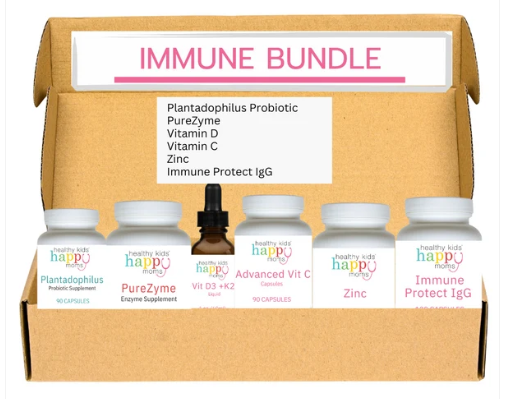
For families who already use our integrative immune-support routine, the HKHM Immune Bundle brings several of our foundational supports together, including Plantadophilus, PureZyme, Vitamin D3 + K2, Immune Protect IgG, Advanced Vitamin C, and zinc.
You do not need an enormous medicine cabinet.
The most useful things are often the simplest: fluids, rest, comfortable breathing, foundational support, and knowing which symptoms require another level of care.
Supplements can be used as part of supportive care, but they do not diagnose, treat, cure, or prevent colds, influenza, or other infections, and they should never replace appropriate medical evaluation.
When your child gets sick, pay attention not only to the cough, congestion, or fever, but to the whole child.
Are they breathing comfortably? Staying hydrated? Interacting with you? Gradually improving?
Those clues can often tell you much more than one symptom alone.
References
- Centers for Disease Control and Prevention. When Students or Staff Are Sick. 2024.
- Centers for Disease Control and Prevention. Manage Common Cold. 2026.
- Centers for Disease Control and Prevention. Treating Flu with Antiviral Drugs. 2026.
- American Academy of Pediatrics. Is It a Cold or Allergies? How to Tell the Difference. 2025.
- American Academy of Pediatrics. Fever: When to Call the Pediatrician. 2022.
- American Academy of Pediatrics. Coughs and Colds: Medicines or Home Remedies? 2022.
- U.S. Food & Drug Administration. Is Rinsing Your Sinuses With Neti Pots Safe? 2025.