One of the most common questions parents ask about is how to give supplements to kids.
Even when parents understand that supplements can support gut health, immune function, sleep, or focus, getting kids to take them consistently can feel like a daily battle.
The good news is that you don’t always have to give supplements as capsules or tablets. With a few simple strategies, you can mix them into foods or drinks your child already enjoys.
Over the years, I’ve helped hundreds of families find creative ways to make supplements much easier for kids to take. These strategies can work for many common supplements used in integrative pediatrics.
The Key Principle for How to Give Supplements to Kids: Small Amounts Work Best
When mixing supplements into food or drinks, the most important rule is simple: use a small amount of food or liquid.
If you mix supplements into a large smoothie or drink, your child may not finish the entire portion. That means they won’t receive the full dose.
Instead, try mixing supplements into a:
- Few spoonfuls of applesauce
- Small amount of pudding
- Small drink that can be finished quickly
- Few bites of yogurt or soft food
Once the supplement portion is finished, your child can eat or drink the rest of their meal normally.
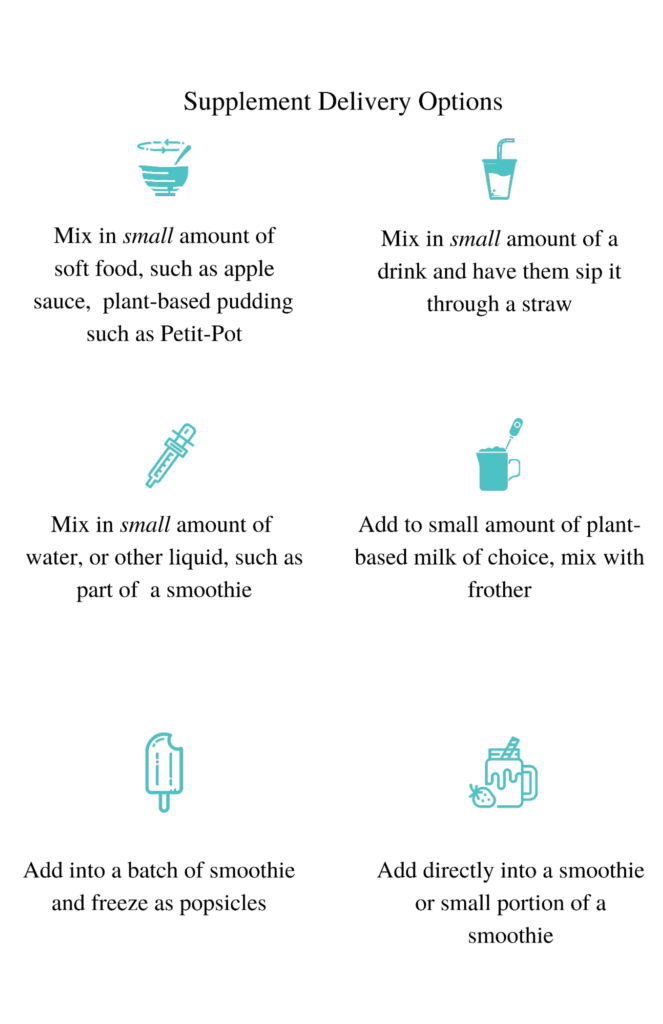
How to Give Supplements to Kids: 6 Easy Mixing Strategies
Parents are often surprised at how flexible supplement delivery can be.
Here are six approaches that tend to work well.
Mix Into Soft Foods
Soft foods can easily hide powders from opened capsules.
Good options include:
- Applesauce
- Mashed banana
- Plant-based pudding
- Yogurt (if tolerated)
This method works well for many powdered supplements as well.
Mix Into a Small Drink
Some supplements dissolve well in liquids.
Try mixing them into:
- Water
- Tart cherry juice
- Electrolyte drinks
- A small portion of a smoothie
Sometimes using a straw helps kids drink the mixture more easily.
Use an Oral Syringe
For children who struggle with taste, a small oral syringe can work very well.
Mix the supplement into a small amount of liquid and administer it gently toward the back of the cheek.
Some families follow this with a small “chaser,” such as chocolate syrup or juice.
Blend Into Smoothies
Smoothies can be one of the easiest ways to deliver multiple supplements at once.
You can mix supplements into:
- A full smoothie
- A small portion of a smoothie
- Plant-based milk mixed with a frother
Some families also freeze smoothies into popsicles, which kids often love.
Add to Plant-Based Milk
Certain powdered supplements mix well with milk alternatives such as:
- Almond milk
- Coconut milk
- Oat milk
Using a handheld frother helps distribute powders evenly.
Freeze Into Popsicles
If your child enjoys popsicles, this can be a great option.
Simply mix supplements into a smoothie or juice mixture and freeze them in molds.
Kids often see this as a treat rather than medicine.
Can Supplements Be Mixed Together?
Parents often worry about whether they need to give every supplement separately.
In most cases, supplements can be mixed together and given at the same time, which simplifies routines for busy families.
However, there are a few exceptions (see more below).
Supplements That Should Be Taken Separately (Important Note on How to Give Supplements to Kids)
Binders
Binders such as charcoal or toxin-binding supplements are best taken:
- On an empty stomach
- 30 minutes before other supplements or meals
- 1 hour after other supplements or meals
These supplements are designed to bind toxins and substances in the digestive tract, so they should not be taken at the same time as other nutrients.
Systemic Enzymes
Systemic enzymes are also best taken away from food, especially protein.
They can be mixed into:
- Water
- Tart cherry juice
- Electrolyte drinks
- Applesauce
Just make sure the mixture does not contain protein, since that interferes with their intended effect.
Unique Method for How to Give Supplements to Kids: Making Magnesium Gummies at Home
Additionally, some supplements can even be turned into kid-friendly gummies.
Magnesium is one of my favorite nutrients for supporting children’s nervous system regulation, sleep, and overall health. If your child doesn’t like capsules or powders, homemade magnesium gummies can be a fun alternative.
Magnesium Gummy Recipe
These gummies deliver approximately one capsule of HKHM Advanced Magnesium per gummy.
Ingredients:
- Optional: 1–2 teaspoons honey or maple syrup
- 20 capsules HKHM Advanced Magnesium
- 1 cup juice of choice (tart cherry works well)
- 3 tablespoons grass-fed gelatin
Instructions:
- Pour ½ cup juice into a small saucepan and sprinkle gelatin over the top. Let it bloom for a few minutes.
- Warm gently over low heat, stirring until gelatin dissolves. Do not boil.
- Remove from heat and stir in the remaining juice and magnesium powder.
- Whisk thoroughly so the powder distributes evenly.
- Pour mixture into silicone molds.
- Refrigerate for at least 1 hour until firm.
Each gummy contains roughly 117 mg of elemental magnesium when made using the full recipe.
Notes on Heat Stability: Our HKHM Advanced Magnesium is a chelated magnesium (TRAACS®) and is chemically stable through moderate heat and formulation processes (like beverage or gummy making). However, prolonged boiling or >80 °C exposure may degrade the amino acid ligand and slightly reduce absorption efficiency. Keeping the mixture below boiling, adding magnesium near 60–70 °C, and cooling promptly preserves efficacy.
How to Give Supplements to Kids: Tips for Success
If you’re introducing supplements to your child, start simple.
Helpful tips include:
- Introduce one supplement at a time
- Mix into familiar foods
- Keep portions small
- Stay consistent with routines
- Make it fun when possible
Many families find that once they discover a method their child likes, supplement routines become much easier. Giving supplements to kids doesn’t have to be stressful. With a few creative mixing strategies, you can turn supplements into smoothies, popsicles, soft foods, or even homemade gummies.
These simple approaches can make it much easier for children to get the nutrients their bodies need to support healthy growth and development.