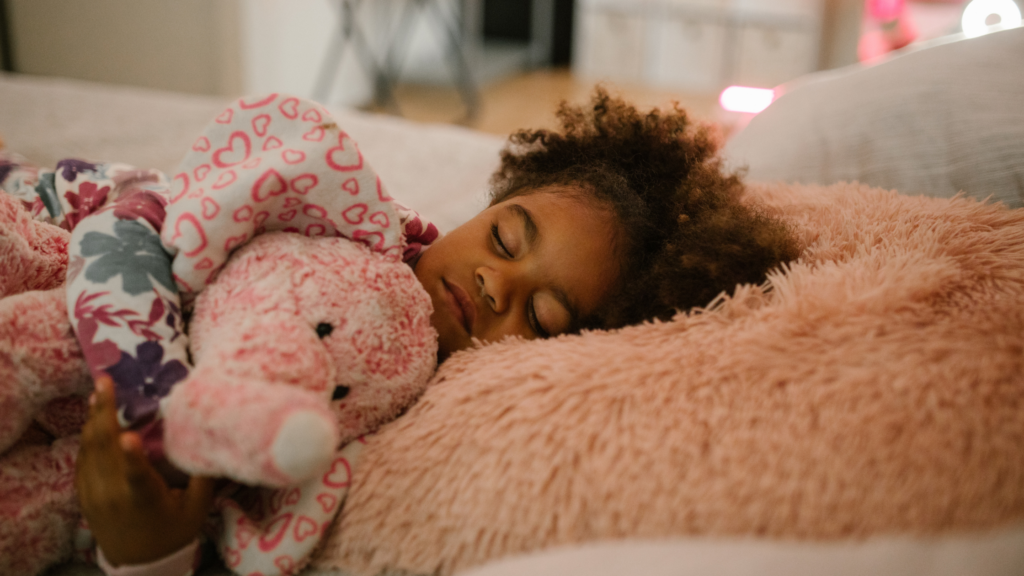
Changes to your child’s sleep routine can be tough, but a few healthy sleep habits for kids can make the transition easier.
Whether you’re adjusting to Daylight Saving Time, traveling across time zones, or simply getting bedtime back on track, even a one-hour shift can disrupt your child’s sleep for a few days.
That’s because our bodies follow an internal clock, or circadian rhythm, that helps regulate when we feel awake and sleepy. Light exposure is one of the biggest signals that keeps this rhythm on track.
The good news? A few simple strategies can help your child adjust more smoothly.
Here are some of my favorites stategies:
Adjust Your Child’s Sleep Schedule Early: Healthy Sleep Habits for Kids
Instead of waiting until the night of the time change, start shifting your child’s schedule a few days ahead of time.
Try moving bedtime and wake time by about 10–15 minutes each day in the direction you need to go.
For young children especially, a gradual adjustment can be much easier than suddenly asking their bodies to fall asleep an hour earlier or later.
Natural light can also help reset the internal clock.
Make a point to get your family outside during daylight hours, especially in the morning. Exposure to natural light helps reinforce the body’s circadian rhythm and can make it easier to adjust to a new sleep schedule.
Bonus points for an early morning walk or a little outside time before school.
Create Healthy Sleep Habits for Kids With a Relaxing Bedtime Routine
One of the most important healthy sleep habits for kids is giving the brain and body a consistent signal that the day is winding down.
About an hour before bed:
- Dim the lights
- Power down screens
- Keep activities calm
- Lower the noise level
- Begin the same basic bedtime routine each night
Reducing screen exposure before bed also means less blue light, which can interfere with the body’s normal nighttime signals.
A warm shower or Epsom salt bath can also be a great addition to the routine. The warm water helps the body relax, and the drop in body temperature afterward can help signal that it is time for sleep.
Bathing before bed also washes off pollen, dirt, and other environmental allergens that may have accumulated throughout the day, especially for kids who have been outside playing sports.
The goal is simple: create an environment that tells the nervous system, “It’s safe to slow down now.”
Use Magnesium to Support Healthy Sleep and Relaxation
Magnesium is one of my favorite foundational minerals for families because it supports muscle relaxation, nervous system regulation, and the pathways involved in healthy sleep.
In practice, I especially think about magnesium for kids who have trouble physically settling their bodies at night.
I often describe it this way:
Magnesium helps prepare the body for rest.
It supports relaxation and the production of calming neurotransmitters that help the nervous system transition toward sleep.
One option I use with families is HKHM Advanced Magnesium.

It is also available as a powder for children who do better with a mixable option.

You can also increase magnesium through foods such as:
- Leafy greens
- Pumpkin seeds
- Almonds
- Beans
- Avocado
What Is GABA and How Can It Support Healthy Sleep for Kids?
GABA stands for gamma-aminobutyric acid.
It is one of the brain’s primary inhibitory, or calming, neurotransmitters.
I like to think of GABA as the brain’s brake pedal.
During the day, our nervous systems spend plenty of time in “go mode.” At bedtime, GABA helps support the shift toward relaxation and rest.
This is where magnesium and GABA work from two different but connected angles:
Magnesium helps prepare the body for rest, while GABA helps the brain shift into rest.
GABA also plays an important role in sleep regulation. In a small randomized, placebo-controlled study of adults with insomnia symptoms, supplemental GABA was associated with shorter sleep latency and improved sleep efficiency after four weeks.
For kids who seem physically tired but mentally wired at bedtime, GABA is one of the tools I may consider as part of a broader sleep routine.
One option I use is GABA with L-Theanine by Quicksilver Scientific.

If you want to learn more, you can dive deeper into a recent blog post on how magnesium and GABA work together for sleep support.
Practice Mindful Breathing for Better Sleep
Sometimes kids need help slowing their minds down just as much as they need help relaxing their bodies. A few minutes of deep breathing or meditation before bed can help shift the nervous system toward a calmer state.
One of my favorite breathing exercises comes from my mentor, Dr. Andrew Weil: the 4-7-8 breathing technique.
Simply:
- Inhale for 4 seconds
- Hold the breath for 7 seconds
- Exhale slowly for 8 seconds
- Repeat 4 times
This type of slow breathing helps activate the parasympathetic nervous system, the part of the nervous system associated with rest and relaxation.
And it doesn’t need to become another complicated bedtime task.
Just a few intentional minutes can be enough to help your child begin winding down.
Keep Your Child’s Sleep Schedule Consistent
Yes, even on weekends. The body thrives on rhythm.
Keeping bedtime and wake time relatively consistent from one day to the next helps reinforce your child’s internal clock and makes transitions like Daylight Saving Time much easier.
That doesn’t mean bedtime can never change.
Birthday parties, holidays, travel, and late nights happen.
The goal is simply to make the usual routine predictable, so your child’s body knows what to expect most nights.
When the clocks change, come back to the basics:
- Shift bedtime gradually
- Get plenty of natural light during the day
- Dim lights and screens before bed
- Keep the bedtime routine calm and predictable
- Support the nervous system with nutrients like magnesium when appropriate
- Use calming tools like breathing and GABA when your child needs additional support
Healthy sleep habits for kids don’t have to be complicated.
A few consistent signals throughout the day and evening can make a big difference in helping the brain and body know when it’s time to rest.
References
- Wang J, Di H. Natural light exposure and circadian rhythm: a potential therapeutic approach for disorders of consciousness. Sleep. 2022 Jul 11;45(7):zsac094. doi: 10.1093/sleep/zsac094. PMID: 35446433.
- Arab A, Rafie N, Amani R, Shirani F. The Role of Magnesium in Sleep Health: a Systematic Review of Available Literature. Biol Trace Elem Res. 2023 Jan;201(1):121-128. doi: 10.1007/s12011-022-03162-1. Epub 2022 Feb 19. PMID: 35184264.
- Byun JI, Shin YY, Chung SE, Shin WC. Safety and Efficacy of Gamma-Aminobutyric Acid from Fermented Rice Germ in Patients with Insomnia Symptoms: A Randomized, Double-Blind Trial. J Clin Neurol. 2018 Jul;14(3):291-295. doi: 10.3988/jcn.2018.14.3.291. Epub 2018 Apr 27. PMID: 29856155; PMCID: PMC6031986.